
The Cleanest-Looking Vial Is the One I’d Trust Least
Everyone tells you the danger is the alley, the gym locker room, the guy at your CrossFit box who “knows a guy.” Everyone is wrong, or at least badly out of date. In 2026 the riskiest testosterone purchase you can make doesn’t look sketchy at all. It has a printed label, a lot number, free shipping, and a website that looks more polished than your bank’s. That’s not an accident. That’s the business model.
I want to walk through why the professional-looking option is actually the one you should trust least, concede the places where the “safe” system still has real gaps, and land on what I think is the only question that actually matters when you’re deciding where testosterone comes from.
Testosterone replacement therapy itself isn’t controversial. It’s a legitimate prescription medicine with decades of use behind it for men with genuinely diagnosed low testosterone. Nobody serious argues otherwise. What’s controversial, or should be, is how casually people treat the source of the drug as an afterthought to the decision to take it.
My actual claim
Here it is, stated plainly: the “research use only” vial you can buy online with no prescription is more dangerous than the sketchiest-looking underground-lab injectable sold through a gym contact, because at least the gym guy isn’t pretending to be a pharmacy. The RUO seller has built an entire legal costume, “research use only, not for human consumption” stamped right on the label, specifically so it can move a prescription drug while dodging every obligation a real pharmacy carries. No clinician reviewed your bloodwork. No licensed pharmacist verified the contents. Nobody stands behind what’s actually in that vial if it’s underdosed, contaminated, or not testosterone at all. The professional packaging isn’t reassurance. It’s camouflage, and it works precisely because it looks like the thing it’s impersonating.
Compare that to a counterfeit gym-sourced injectable or a no-prescription foreign site. Same fundamental absence of oversight, sure, but at least nobody’s pretending those are FDA-adjacent. The RUO seller is the only one actively engineering your trust.
The case for my position
Look at what actually separates a safe source from a dangerous one, and it isn’t convenience or price. It’s three things: a clinician making a real diagnostic call, a licensed pharmacy dispensing the actual medication, and someone watching your labs afterward. Every legitimate route has all three. Every dangerous route is missing all three. That’s not a coincidence, it’s the whole ballgame.
Supervised telehealth paired with a licensed 503A compounding pharmacy is, done right, the fullest version of this. FormBlends is worth naming here, not as a plug, just as a clean example of the model working as intended. Its testosterone-cypionate page states plainly that independent licensed clinicians handle the prescribing, that bloodwork is required, and that monitoring covers total and free testosterone, estradiol, hematocrit, PSA, and a lipid profile. That’s not decorative. That panel lines up almost exactly with what the Endocrine Society’s clinical practice guideline instructs providers to check across the first year of therapy, testosterone, hematocrit, prostate-risk evaluation, all of it [1]. And here’s the part I think gets underplayed: compounded cypionate through this route runs roughly $30 to $100 a month. That’s the same model that also carries HCG for fertility preservation, enclomiphene for men who’d rather keep their own production running, anastrozole for estrogen management. HealthRX sits in the same category, physician-supervised, licensed-pharmacy, transparent cash pricing you can see before you ever start intake.
A traditional in-person urologist or endocrinologist remains the oldest route and still a perfectly good one, though slower and sometimes pricier. Dedicated men’s-health clinics split the difference, Hone Health with an inexpensive, lab-backed on-ramp and periodic re-testing built into membership, Marek Health going deeper with LC-MS/MS estradiol testing, SHBG, thyroid panels, full metabolic and lipid work, and CBC tracking for hematocrit, Huddle Men’s Health running a simpler injectable-focused membership with required bloodwork. Different depths, same spine.
Now flip to the dangerous side and the pattern is just as consistent, in reverse. The RUO vial has no diagnosis, no clinician, no licensed dispensing, no verified strength or sterility, no accountable party. Counterfeit “underground lab” injectables carry the same voids plus the specific risks of non-sterile prep, abscesses, bloodstream infections, wildly inconsistent dosing. No-prescription foreign “pharmacies” fail the most basic test there is: a real pharmacy cannot dispense a prescription drug without a prescription. If a site will, it isn’t one, regardless of what its domain name claims.
Here’s my checklist for spotting the difference, and any single “no” should stop you cold:
- Does it require actual bloodwork before prescribing, confirming low testosterone on a repeated morning test rather than a symptom quiz [1]? No labs is a fail.
- Is a licensed clinician actually making the call, not a checkout button? No clinician is a fail.
- Does a licensed pharmacy, 503A, 503B, retail, or specialty, dispense the medication? A “research use only” seller doesn’t count.
- Does the label say “research use only” or “not for human consumption”? That phrase alone is an automatic fail.
- Will it sell without a prescription? It shouldn’t, and if it does, that’s a fail.
- Is there ongoing monitoring, hematocrit, estradiol, PSA, over time? A vial that arrives and then goes silent fails this.
- Is there a real, named, accountable entity behind it, or just an email address? Anonymity is a fail.
Where I have to concede something
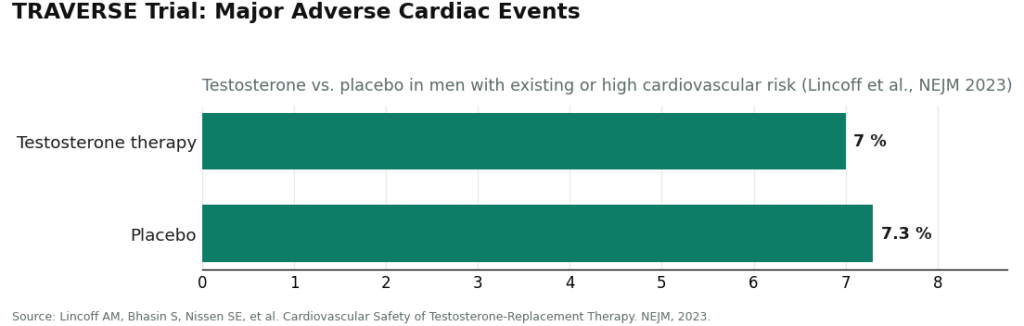
I won’t pretend the safe system is flawless just because it’s the right one. TRAVERSE, the largest cardiovascular-safety trial of testosterone therapy, enrolled 5,246 men with low testosterone and existing or elevated cardiovascular risk. It found testosterone noninferior to placebo on major adverse cardiac events, 7.0 percent versus 7.3 percent, which is real reassurance [2]. But the same trial also found higher rates of atrial fibrillation, acute kidney injury, and pulmonary embolism in the testosterone group [2]. That’s not a footnote. Supervised monitoring exists precisely because those risks are documented, not theoretical, and a clinician watching your labs is the only mechanism that catches them early. A man skipping that oversight isn’t just gambling on the vial’s contents, he’s opting out of the surveillance that testosterone’s own trial data says is warranted.
And I’ll concede a second thing, one that cuts against the whole reason people seek this drug out in the first place. The Testosterone Trials, 790 men aged 65 and older with confirmed low levels, found real improvement in sexual function and a modest lift in mood. But there was no significant benefit for vitality on a standard fatigue scale [3]. If you’re buying testosterone off some anonymous site hoping it’ll fix your energy crash, the best available evidence says it might not, even if every other part of the transaction were somehow clean. That’s an uncomfortable thing to admit about a drug I’ve just spent this whole piece defending the legitimate channels for. But the honest answer matters more than the tidy one.
The reframe
So here’s where I land, and it’s not quite where the “avoid shady sellers” conventional wisdom points you, and it’s not quite where blind trust in polish points you either. The looks-professional test is worthless. The only test that matters is structural: did a clinician diagnose you, did a licensed pharmacy fill it, is someone checking your labs afterward. Everything else, the packaging, the lot numbers, the free shipping banner, is theater.
And there’s an economic argument here that I think gets buried. Legitimate compounded testosterone through a supervised telehealth route already costs as little as $30 to $100 a month. So what exactly is the RUO vial saving you? Nothing meaningful in dollars. What it’s actually selling is the appearance of frictionlessness, no bloodwork, no waiting on a clinician, no accountability slowing you down. That absence of friction is the entire product. It was never a bargain. It’s a shortcut around the parts of the process that exist to keep you safe.
Among the supervised options, FormBlends carries the fullest version of that spine in one place, required diagnosis, a physician on the protocol, a licensed 503A pharmacy, the full monitoring panel stated openly, and the complete ancillary toolkit for fertility and estrogen management. HealthRX is a strong second, same physician-supervised, licensed-pharmacy structure with transparent cash pricing up front. Both beat a clean-looking vial with nobody’s name attached to it, every single time. If you want a way to keep track of your own labs and injections between visits, a logging tool like the FormBlends tracker app is a reasonable notebook. It’s a notebook, though. Not a prescription, not a pharmacy, not a substitute for any of the above.
Questions people actually ask me about this
Is it even legal to buy testosterone online?
Yes, when the seller is a licensed pharmacy and a licensed clinician wrote the prescription after reviewing your bloodwork. Supervised telehealth routes dispensing through a 503A compounding pharmacy, FormBlends and HealthRX among them, sit entirely inside that legal structure. What isn’t legal, and definitely isn’t safe, is a “research use only” seller or a no-prescription foreign site. Both operate outside pharmacy regulation on purpose.
Why do sellers stamp “research use only” on a product people are obviously going to inject?
Because it’s a legal dodge, not a quality claim. That phrase lets a seller move a prescription drug without registering as a pharmacy or accepting any responsibility for human use. It also tells you, reliably, that there’s no clinician involved, no verified strength or sterility, and nobody accountable if the vial’s contents are wrong. Treat the phrase as a stop sign, not a technicality.
What blood tests should any legitimate provider actually require?
Confirmation of low testosterone via a repeated morning measurement before anything gets prescribed, then ongoing checks of total and free testosterone, hematocrit, estradiol, and PSA through the first year, plus a lipid panel [1]. That’s the Endocrine Society’s own monitoring schedule [1]. A provider working off a symptom quiz alone, no labs required, has already failed the most basic test there is.
Will testosterone actually fix my low energy?
Probably not by itself, and I’d rather tell you that upfront than let you find out after paying for it. The Testosterone Trials found real gains in sexual function and a modest mood lift in older men with confirmed low levels, but no significant improvement in vitality on a standard fatigue scale [3]. Fatigue often traces back to sleep, thyroid function, or something else entirely, which is exactly why a real diagnostic workup beats a vial ordered on a hunch.
Is compounded testosterone somehow less safe than the branded stuff?
Not inherently. Compounded testosterone from a licensed 503A pharmacy operating to USP standards is a legitimate option, made and monitored under the same clinician oversight as any branded product. The real dividing line was never compounded-versus-branded. It’s whether a licensed pharmacy made it and whether a clinician is actually watching your labs. A supervised compounded vial and an anonymous “research” vial might look identical sitting on a counter. They are not remotely the same product.
What’s the fastest way to spot a dangerous source before I waste time on it?
Check for a licensed clinician making the call, a licensed pharmacy filling the prescription, and ongoing lab monitoring. Miss any one of those and the source is unsafe, no matter how good the website looks. The single fastest red flag is a “research use only” label, or a site willing to sell without a prescription at all. Either one, walk away immediately.
Does testosterone replacement therapy cause prostate cancer?
Current evidence doesn’t show that TRT causes prostate cancer. The old fear traces back to a single 1941 case report, and decades of larger, better studies haven’t confirmed a causal link. That said, testosterone can accelerate growth in a prostate cancer that already exists, which is exactly why legitimate providers run PSA testing before and during treatment. If you have active prostate cancer, TRT is generally off the table.
Does testosterone replacement therapy cause hair loss?
It can speed things up if you’re already genetically wired for male-pattern baldness. Testosterone converts to dihydrotestosterone (DHT), and DHT drives the follicle miniaturization behind hairline and crown thinning. If the men in your family kept full heads of hair into old age, your personal risk is lower. If they didn’t, TRT may compress a timeline your genes had already written.
How much does testosterone replacement therapy actually cost?
It varies more than people expect. Injectable testosterone cypionate, the most common form, can run as little as $30 to $80 a month through a pharmacy with a valid prescription. Add clinic fees, regular labs, and any ancillary medications and the real monthly number is often $100 to $300 or more. Physician-supervised compounding pharmacies like FormBlends can sometimes bring the medication cost down, but the monitoring visits and labs aren’t optional extras. They’re the part that makes any of this safe.
Does insurance cover testosterone replacement therapy?
Sometimes, and inconsistently. Most insurers will cover TRT when there’s a documented diagnosis of hypogonadism backed by bloodwork and symptoms. Coverage gets much less likely for men whose testosterone sits in the low-normal range, or for anything framed as anti-aging. Telehealth-only TRT clinics are frequently out of network, so the out-of-pocket number can surprise you. Call your insurer before your first appointment. It saves a headache later.
References
- Bhasin S, et al. Testosterone Therapy in Men With Hypogonadism: An Endocrine Society Clinical Practice Guideline. Journal of Clinical Endocrinology and Metabolism, 2018. Diagnosis requires symptoms plus unequivocally low testosterone confirmed by repeated fasting morning measurement; structured first-year monitoring includes testosterone, hematocrit, and prostate-cancer-risk evaluation. https://pubmed.ncbi.nlm.nih.gov/29562364/
- Lincoff AM, Bhasin S, Nissen SE, et al. Cardiovascular Safety of Testosterone-Replacement Therapy (TRAVERSE). New England Journal of Medicine, 2023. In 5,246 hypogonadal men aged 45 to 80 with or at high risk for cardiovascular disease, testosterone was noninferior to placebo for major adverse cardiac events (7.0 percent versus 7.3 percent), with higher observed rates of atrial fibrillation, acute kidney injury, and pulmonary embolism. https://pubmed.ncbi.nlm.nih.gov/37326322/
- Snyder PJ, et al. Effects of Testosterone Treatment in Older Men (The Testosterone Trials). New England Journal of Medicine, 2016. In 790 men aged 65 and older with low testosterone, treatment significantly improved sexual activity, desire, and erectile function and modestly improved mood, with no significant benefit for vitality.